Wednesday, August 24, 2016

The Acadian French of PEI


My island visit was about to come to an end 
but I made one last stop at the Acadian museum in Miscouche near Summerside.


 Prince Edward Island has been inhabited for thousands of years.  Recent archeological excavations prove that people were living here at least 10,000 years ago.  Their descendants, the Mi'kmaq,  were probably the people the first French explorers encountered when they arrived on the Island in 1534.  

They called the island, Isle Saint Jean.  Eventually the French settled and farmed the area until the 'Expulsion of the Acadians'.

This was the beginning of the mass deportation of the Acadians from Canada...

In 1758, the British captured the fortress at Louisbourg, forcing France to surrender both Ile Royale and Ile Saint Jean.  The population of the island at the time was about 5,000.  An estimated 3,000 of them were deported to France.  About 700 of the deportees perished when one of the ships sank in the English Channel.  Many more died on board the other ships. Those 2000 remaining on the Island hid  or escaped to the mainland and sought refuge there.


Those Acadians that were able to get back to the Island some years later found that their land was now owned and occupied by the English.  In order to stay on the Island, the Acadians were obliged to become tenants to the English landowners. Relations were understandably strained.  

From a letter written by  the missionary priest de Balonne in August of 1800...
"There are now three Acadian settlements,  in Malpeque, Rasticot and in Bay Fortune.  In each case the settlements were formed by two or three families who produced many offspring, but without ever marrying anyone else, so that in each of the localities you will find that everyone is more or less related. I cannot disapprove of the aversion they have for marrying their neighbors (the English, the Scots or the Irish) because it has meant that they have kept their faith, their customs and their piety intact. The result is that all the marriages are between relatives, and until I arrived second cousins were being married without any difficulty."

Though that friction between the different communities is no longer so noticeable, the vestiges are apparently still there.    In one town the names of the businesses, streets and monuments are all about the English or the Scots and 5 miles away all the names change to Arceneaux, LaBlanc, Hebert, and Poirier.   The rivers are Riviere Saint Something,  the towns become Saint Whomever and the language is abruptly switched by clerks, waitresses, and children from English to French, then back again.


I thought it might be interesting to compare the Acadian food to the Cajun food of La.  Well, there is no similarity at all.  Where the spicy Cajun cuisine will give you heartburn for a week and raise your cholesterol to the 'oh my god!' level,  the Acadian French cuisine is somewhat bland and boring. (My heart doctor would love it)  
The plate I ordered was called Acadian Feast:  Rapure, meat pie, Chicken Tricot and Coquille Evangeline.  It was okay but a little garlic and cayenne would have helped a lot.  An interesting item on that plate was the black liquid in the little cup--molasses!  I am not sure what it goes with so I just tried it with everything.  It helped. 


A natural connection between the Cajuns of La. and the Acadians is their love of music and dancing.

One of the oldest references to Acadian dance on P.E.I. is a comment made by a visiting Presbyterian minister in 1770, "...he describes the evening he spent at the home of an Acadian family, "At 9 pm went to a house where the French were convened, had a dance and spent the evening in jollity."


Most gatherings, parties, and dances were held in the kitchen, which was usually the largest and warmest room of the house.  Living rooms were usually reserved for special occasions and not for 'soirees' where there would be a crowd of people and square dancing.  These parties often took place on special occasions such as weddings and Shrovetide.  The dancing would start after supper and often last until dawn.  Kitchens filled with as many dancing couples as the space could hold.  A local fiddler or mouth organ player provided the music.


Deacon Cyrus Gallant, a well-known dancer, described how popular dance was in the early decades of the 20th century:
"It was like there was a heartbeat in the room, and they couldn't avoid it.  They had to jump on the floor, and we can't describe that, because you don't see it anymore.  They just couldn't stay off the floor."


This spectacular church and the accompanying cemetery ...


...had prime ocean view.


Prince Edward Island is definitely worth the effort it took to get there.  I am really glad I did it.  Now it was time to head to Nova Scotia.  I noticed that I barely slept that night before leaving; perhaps it was the blowing wind and rain on my roof,  or possibly my fear of that narrow bridge with the ocean far below me.

(Items in Italics are from literature provided by the museum)

Sunday, August 21, 2016

Bottle houses on PEI

I know that the men that read this blog care little for the pictures and stories about vintage houses and 12-year-old storybook girls.  But this may be more appealing to them--houses built out of beer, wine and liquor bottles!

I found this little roadside attraction as I drove the coastal road from the Confederation bridge to the very Acadian French village of Abram.


This giant bottle made up of over 2,000 recycled bottles was built in 2002 by Etienne Gallant, grandson of Edouard Arsenault, builder of the three bottle houses situated on this property.

Edouard had intended to build such a structure at the entrance but his wish only became a reality twenty years after his death, completed by his grandson.


The pathway leading to the bottle houses illustrates a great care in gardening.   


(Sorry, Guys...I can not resist babies, pets and flowers)


Back in the 1980's there was little, if any interest in recycling, hence lots of bottles were left lying around.


Mr Arsenault found a very creative way to use them.


The setting alone was worth the visit...


and with two bottle trees! 


This is the first house built by Edouard T. Arsenault in 1980, using approximately 12,000 bottles.  The structure was severely damaged as a result of the yearly spring thaws and was rebuilt using the same bottles and design in 1995. 


The entire project started as a hobby but grew as did the interest in it by fellow islanders.    In 1980 there was little or no recycling for glass--it was mostly sent to the dump.  So each week, Edouard took his old truck and gathered bottles from local dancehall, restaurants, bars and of course, the dump.  People heard about his project and started bringing him bottles.  Eventually, people brought some from all over the world.


The light shining through the bottles was--well, interesting....


...but there had to be a backside.


Friends and family remember Edouard for his pride in his Acadian roots.  


When he was young, he learned to play, by ear, the pump organ.  Like the Cajuns of Louisiana,  the Acadians love  music.


From the door you could see a replica of the Cap-Egmont lighthouse. 
 Edouard was the last resident keeper of the local lighthouse. 


His houses also had a great view of the ocean.


The Tavern  


The Chapel

Edouard Arsenault started building this chapel in 1983 and used approximately 8,000 bottles.  It is his last monument as he passed away in his sleep in 1984.


Look closely at the pews and notice that bottles were not the only glass objects used in the construction.  Back in the 70s, local Catholic parishes discarded their colorful votive holders after use so Edouard collected them for his project.  


In the chapel are beer bottle crosses and a variety of liquor bottles make up the altar.  
Yes, there have been a few weddings in this chapel.


A fisherman by trade, Edouard also worked as a carpenter.  His creative energy and his sense of humor very much Acadian, were channelled in his project of transforming over 25,000 bottles into the colorful souvenirs that he has left behind.


Saturday, August 20, 2016

L.L. Montgomery and Anne of Green Gables

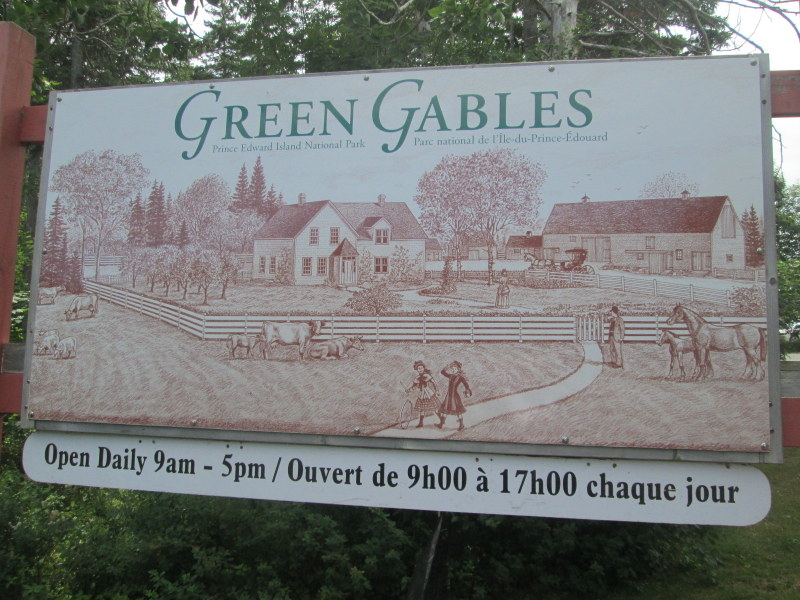
I spent an afternoon exploring this farm and reliving the stories of Anne of Green Gables  and the fictitious town of Avonlea.  I felt the farm and the words of Lucy Maud Montgomery were as descriptive of Prince Edward Island today as they were to Avonlea in 1908.  


In the late 1800s this farm belonged to David and Margaret Macneill, cousins of Lucy Maud Montgomery's grandfather.  As a girl, Montgomery often wandered through their woods and later she made the farm famous as the setting of "Anne of Green Gables", her best-loved work of fiction.

(Lucy Maud Montgomery)

The literary works of Island-born author, Lucy Maud Montgomery have achieved international acclaim.  Her first book, Anne of Green Gables, was published in 1908. 


  Nineteen more novels and many more short stories and poems followed, all inspired by her great love of Prince Edward Island's landscape and cultural life.  Her work has since been translated into at least seventeen languages and is enjoyed around the world.

(Lucy's grandparents, Lucy Woolner Macneill (1824-1911) and Alexander Macneill (1820-1898)

Lucy Maud Montgomery was born in New London, Prince Edward Island in 1874.  She was raised by her maternal grandparents in Cavendish after her mother died of illness when Maud was 21 months old.  Maud's father, unable to care for an infant, moved to Saskatchewan.   

(Rev. Ewan MacDonald)

 Lucy did not leave Cavendish permanently until after her grandmother's death in 1911, when she married the Rev. Ewan MacDonald and moved with him to Ontario to start their own family.


Anne of  Green Gables is a fictitious story about a young orphan who is mistakenly sent to live with an aging brother and sister, Matthew and Marilla Cuthbert, on their farm called Green Gables. 
  

The story is set in rural Prince Edward Island in the late 1800s and its heroine, Anne Shirley, is a red-haired, freckle-faced girl--full of imagination and spirit--who despite her many misadventures soon endears herself to everyone in the imaginary village of Avonlea.


Lucy often visited the Green Gables house and it became the setting for her stories about Anne.


The house has been maintained and is now protected by the Province but the furnishings have been supplied by the townspeople of Cavendish.


The local people are so proud and protective of L.M. Montgomery and her stories that they have provided the furnishings for the house from their own attics and basements.  


All of the furnishings in the farmhouse date to the period of the stories.


Great effort was taken to match the look and feel to the descriptions in the stories.


Lucy Maud Montgomery never lived in the Green Gables house.  She was born in a smaller farmhouse a few miles away.  Her grandparents house where she eventually lived was a mere 15 minute walk through the woods.  That house no longer stands.


The Green Gables house is now one of the single most popular attractions in all of Canada.


It was particularly fun to watch the little pre-teen girls as they spied things in the house and on the grounds that reminded them of some part of the books.  They would share with anyone near them that this scene or that adventure occurred in that spot.


This is the view looking from the front door of the house and it is completely like the countryside throughout Prince Edward Island.


The woods that stretched between the two farmhouses. 


The Haunted Wood follows an easy 3/4 mile loop through the grove.  Montgomery imagined these woods to be full of mystery, especially after dark, and lent the haunted wood to Anne and the other characters of Avonlea in "Anne of Green Gables. 


"I am grateful that my childhood was spent in a spot where there were many trees...When I have lived with a tree for many years it seems to me like a beloved human companion."  L.M.M.


Montgomery's Haunted Wood was really...a harmless, pretty spruce grove that connected her grandfather's farm to the Macneill's house.  "Listen carefully though--in the wind these spruces groan and creak with the voices of imagined ghosts. "


In her early childhood, Montgomery had many spirited conversations with imaginary friends.  She said they were 'real folk to my imagination'.  


Look and listen carefully--In ferny dells with brooks slipping through them.  Montgomery could almost believe in fairies...'You always just miss them...but their laughter floats back to you in the sudden whisper of the wind and the puckish rustle of the aspen. '


"As I walked up the Old Lane I would see the kitchen light shining through the trees. I would pass under the birches...and then around the curve. The old house would be before me."  L.M.M.

(The foundation of her grandparents farm)

"I consider it a misfortune to love any place as I love this old homestead...the agony of parting from it is intolerable.  I love this old home deeply, and I love Cavendish."

"Oh beloved old place..Have not old homesteads souls that cling to them until they crumble to dust?" L.M.M.


"...the incidents and environment of my childhood had a marked influence on my literary gift.  Were it not for those Cavendish years I do not think "Anne of Green Gables" would ever have been written." L.M.M.


"The old house lay before me in silvery shadow.  I turned aside for a moment to the old well and looked down it..." L.M.M.


"The peace and quiet of this dear old place is very sweet to me.  There is no place on earth I love or ever will love as I do it."  L.M.M.


"My garden...the delight it has been to me...I am positively reveling in flowers--dozens of the most lovely blossoms." 


" It is the greatest pleasure my days bring to me to go out to my garden every morning and see what new blossoms have opened overnight."  L.M.M.


"...the trees that whispered nightly around the old house where I slept, the woodsy nooks I explored, the homestead fields, each individualized by some oddity of fence and shape."  L.M.M.


 The woods below L.M. Montgomery's cousins' home inspired her descriptions of the hollow below Green Gables "where the brook ran and where scores of birches grew, upspringing airily out of an undergrowth of woodsy things."  


Many of the places Montgomery described so lovingly are now preserved and protected for future generations in Prince Edward Island National Park.


Close to 500,000 visitors find their way to Green Gables each year.

In 1943, L.M. Montgomery was recognized by the government of Canada as a person of national historic significance. 


(I found the entire series of Montgomery's books about Anne Shirley as Kindle ebooks  on Amazon.com for the huge sum of ninety nine cents!  Of course I bought them and just may have to reread them someday.)