Saturday, August 3, 2013

Saying Goodbye

 NOTE:  Today is the last day of my two years on the road--yet I'm not ready to stop!  Am I having fun? What a silly question.
Finally, I just checked the blog tally.  One year ago there was a total of 10,000 page views of the blog.  A few minutes ago that number rolled over to 45,000!  Pretty cool, guys.  Thanks.


Ron and I were up and on the road by 7AM.  We had to be in Brooks by 8AM for him to catch the shuttle to the Calgary airport.  The clouds were getting heavier and rain had begun falling by the time we started out.


15 minutes after leaving the park we encountered this herd of cows in the middle of the road.


They were in no hurry to move along.


Hmm, rain and cows--the stress level was rising.


I shouldn't have worried--we made it in time.  


I had planned to go on to Calgary for the Stampede but the weather was supposed to stay stormy for the rest of the week.  Anyway, I needed to slow down for a while so, after waving a final goodbye to Ron, I turned south and headed to Ft. McLeod to wait out the bad weather.
 

While I was in Lethridge a hailstorm came through.  It was my first in the RV and it was so strong I worried there would be damage to the vehicle.  But no, none that I could find. But hail stones were piled up all along the streets and I even saw merchants shoveling the hail away from their doors. (Why didn't I take some pictures?  I don't know.)


Later I was talking to a local who informed me the hail had destroyed most of the crops in the area and many of the farmers were suddenly in bad shape. Talk about stress!  Life as a farmer must be as tough as ...
 
...well, a beekeeper's life.  These are shelters for the bee colonies that are brought into the fields at different intervals. Yes, bees are dying in great numbers and the keeper's are worried about their future as well.


It was very lonely for me when Ron left.  He is so easy to travel with and his energy really gave me a boost.  Plus, I so appreciate the effort he put into planning the week and picking the places that will forever stand out in my mind as highlights of this voyage.  Thank you, Ron.
Besides, I have my faithful traveling companion--the only cat I've known that sleeps with her head on a pillow.

Friday, August 2, 2013

Dinosaur Provincial Park

This is another of those jaw-dropping sites that I was completely unaware of.  We camped here for two nights and could have stayed much longer if we'd thought to bring a pick and a shovel.

Dinosaur Provincial Park, established in 1955, is like no other place on Earth.  In 1979 the UN Educational, Scientific and Cultural Organization (Unesco) formally acknowledged the park's natural, scientific and spiritual importance by designating it as a World Heritage Site.   


Native people believe the badlands are the home of spirit beings, and they have always come here to communicate with the spirit world.  


Dinosaur Provincial Park is exceptional for the abundance and diversity of fossils that are found here.  During the past 100 years thousands of fossils have been collected from this area.  More than 40 dinosaur species are known from the Park.  


Exploration of the Park began in the late 1800s.  Today, researchers from the Royal Tyrrell Museum continue to uncover fossils, providing new information about the plants and animals that lived here 75 million years ago.

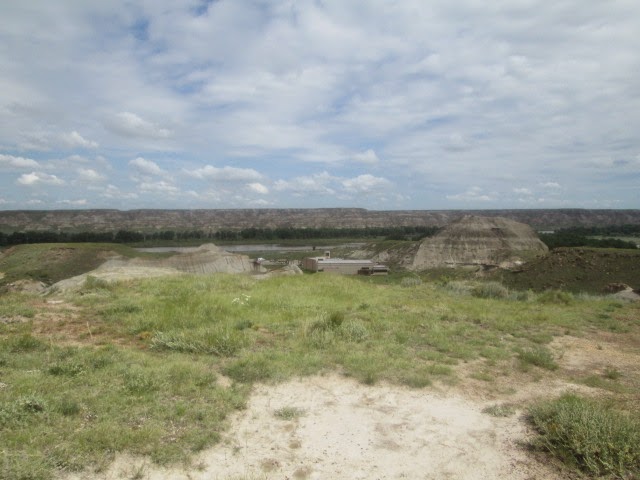
The instant transformation from flat prairie to this incredible canyon is stunning.


It is an ever-changing landscape as inches of sand, rock and sediment are washed away with each rain or wind storm....
  
....exposing fossilized bone-beds that are many millions of years old.  This constant change is what draws both amateur and professional paleontologists from around the world.


But the scenery alone is worth the visit.


This is an excavation in progress of a hadrosaur.

The fossilized bones were brushed with a glue hardener to give them strength and prevent splintering.


Hadrosaurs, also known as duck-billed dinosaurs were large plant eaters weighing as much as four metric tons.  Very abundant 75 million years ago, they account for approximately one-half of all known dinosaur fossils from Dinosaur Provincial Park. 


The Red Deer River is the primary carver of this canyon.
I am utterly fascinated by the realization that these great caches of bones, now being uncovered, are being reassembled into creatures that no man alive has ever seen in the flesh. It has only been approximately 150 years (out of man's entire history!) that we have been aware of what these bones depict.


This was one of the few times I could catch Ron sitting.  "For a hiker, this place is awesome."   

If I could start my life over I would have to devote part of it to the science of paleontology.

I think it is my enjoyment of jigsaw puzzles that fuels that desire.  The knee bone's connected to the thigh bone's connected to the hip bone.....Viola!  A Dinosaur!

Would I know a femur if I saw it sticking out of the wall of one of these hoodoos?


So much about this world and this universe has been learned in my lifetime.  I would only hope that kids today could realize that the 'age of discovery' has not ended but is just beginning.


Storms were gathering again and Ron was leaving very early the next morning.  


 Wow!  What a week!

Thursday, August 1, 2013

Dinosaurs--part 2

When my husband and I first moved to Santa Barbara, Ca. we bought a house that was 90 years old.  It had a yard very overgrown with vegetation and  I was determined to weed out all the unwanted tangle of growth and return the yard to its original glory.  One day, sitting on my knees by a flower bed, I plunged a hand deep into a matte of weeds and ferns and suddenly a reptilian creature about a foot long came charging at me from the undergrowth--it raised up on its longer hind legs and, with mouth agape, bared its nasty looking razor-like teeth (okay, I may be exaggerating here).  Now I must confess a character flaw that has plagued my conscience for some 30 years--I grabbed a shovel and chopped that guy into a dozen one-inch-pieces!


Some time later I learned I had executed a member of a rare lizard family and this particular breed was on the very edge of extinction! For all I know, he was the last one.  I do know--he was the very last reptile I have knowingly annihilated.


 It was during the Cretaceous Period, when dinosaurs reached their evolutionary peak, that a massive extraterrestrial impact initiated the Cretaceous Extinction.  Dinosaurs, ammonites and marine reptiles were among the 50% of Earth's species that disappeared.


Son, Ron, is 6'3" tall and this is a 'medium sized' sauropod leg that lived 155-145 million years ago in the late Jurassic Period.
The Camarasaurus was one of the most common sauropods in western North America.  They were long-necked and were the largest animals to walk the earth. Adults are estimated to have reached lengths of up to 70 feet and weights of up to 47 tons.


The armoured Stegosaurus had large plates along it back and distinctive tail spikes.  They also had a very small brain and simple jaws and teeth.  Stegosaurs went extinct during the Early Cretacous,  

Allosaurus was the most common carnivorous dinosaur of the Jurassic Period in North America.  It was the top predator of its time--equipped with sharp, pointed, serrated teeth ideal for tearing flesh.  In this scene, Allosaurus has a helpless Camptosaurus on its back. 
  
Is there any doubt some of these reptiles were the predecessors of the birds?

The museum had many fish and amphibian fossils like this turtle that were indicators of the vastness of the Bearpaw Sea.

Eryops was a large carnivorous amphibian.  Although able to walk on land, it probably spent much of its time in the water.  With only its eyes and nose visible, it would float near the surface, waiting to catch unsuspecting prey.

These are the fossilized remains of the world's largest-known marine reptile, the ichthyosaur Shonisaurus Sikanniensis.  At 69 feet long it is 30% larger than any previously known ichthyosaur.  It took 3 summers to excavate this 'Triassic giant' from its location along the shores of the Sikanni Chief River in Northeastern British Columbia.
They first appeared about 245 million years ago at the beginning of the Mesozoic Era and died out about 100 million years ago.
(The diagram on the floor that indicated the size of this creature stretched out into another room)

A Dimetrodon of the Permian era.  Scientists are unsure but it is possible that their 'sails' were used for display to attract mates or to discourage competitors.


Here, I think of the lizards that travel along the back wall around my house in Tucson.  When confronted by a competitor they will raise up and fan out their colorful necks--but they never fight.


Pachyrhinosaurus lakustai has a large bump on the nose rather than a horn.  It was named for Al Lakusta, a high school science teacher who first found rib fragments of this species in 1974.
(I love the idea that a science teacher with such an unpretentious name got a dinosaur named after him.)


Centrosaurus apertus dominates several bonebeds in Dinosaur Provincial Park, including the largest ceratopsian bonebed known.  Containing the remains of over a thousand individuals of the same species, this mass grave provides evidence that some dinosaurs travelled in herds and displayed social behavior.


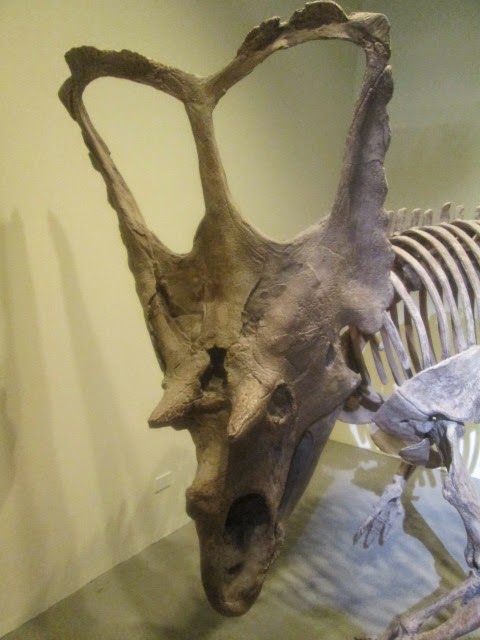
Anchiceratops ornatus was first discovered in 1912 along the Red Deer River.  The rectangular frill was edged by large triangular bony projections and has large orbital and nasal horns.


When discovered in Alberta in 1902, Stegoceras became the first dome-headed dinosaur known to science.  Its name means "horned roof" and refers to the assortment of bony knobs protruding from its skull.  75 million years ago.


I can't help it--this guy looks so 'extraterrestrial' to me.


A large blade-like crest that curves forward distinguishes this species of Lambeosaurus.  This specimen was buried rapidly after death, resulting in the preservation of a complete skeleton with skin impressions along the neck and forelimbs.

 
Gorgosaurus...a carnivore with robust jaws and serrated teeth.  Sturdy hind legs and clawed feet, an efficient killer and an opportunistic scavenger.

If you made it this far then I am impressed.  I hope this shows some of the incredible diversity of life that has come and gone from our planet.  If a spaceship from another galaxy visited us during the 200 million years when these animals were alive then they went away with a far different idea of life on Earth.
This museum was fascinating and well worth visiting.  Ron and I left here late in the day and headed to our campground where we would be for two nights. It is the place that most of these fossils were found.
(to be continued)