Sunday, October 2, 2016

Springfield, Mass. Museums

Springfield, Massachusetts has an entire block in the downtown area devoted to museums--Natural History, Fine Arts, Oriental Arts, Modern Arts, and Dr. Seuss.  


Dr. Seuss was why I stopped here but I found a lot of other stuff to occupy my afternoon.


So, who is stalking whom?


 When I saw all these stuffed wild animals I had to find out how they got here. 
Were they trophies? Pets? 


"From the Zoo,"said the Docent.
"They all died of old age or illness"  Hmm, I hope I can believe him.


Maybe he was right.  He apologized for the condition of these two scraggily fellows.  He explained they were old and rather tattered when they died.  


The Docent's attitude about stuffing animals led me to thinking about our attitudes about our own demise.  What if the Egyptian culture for preserving the deceased had continued into today.   


 Hmm, 1000 years from now, I want to be glued up on a board and displayed in a museum next to King Tut.  (I'm wondering if I am beginning to lose it--perhaps I've been on the road too long.)


Time for some more traditional conservative culture....


From the Currier and Ives Collection:
George Washington (Date unknown) 
By the time the country celebrated the centennial of George Washington's birth in 1832, the man had become an important symbol of freedom, courage and the potential of a still young nation.  This print draws on a famous rendering by Gilbert Stuart (1755-1828) which was also used on the one dollar bill.  


From the Currier and Ives Collection:
Martha Washington, (Date unknown)

Martha maintained a cheerful disposition, fulfilling her expected duties as the First Lady.  (UGH!) She learned to read and write in an era when most women were not expected to do so.  She burned nearly all of her husband's correspondence before her death but one remaining letter from George to Martha indicates a happy and loving partnership.  In the letter he writes to Martha, "...more real happiness and felicity in one month with you at home, than I have the most recent prospect of reaping abroad."

The next stop was the Modern Art Museum...
 

Seventy Two Legs, 2010  by Thomas Shields

The Museum commissioned this artist to create this unique bench for the Contemporary Gallery.  The whimsical bench seats 8 to 10 people and it is the artist's hope that visitors will sit on the sculpture to contemplate the artwork.  (If 10 people sit on these chairs 1/2 of them are going to have their legs in their neighbors laps)


Odalisques
John Grillo used color and light to realize this large-scale abstracted painting.  Typical of his style, 
4 Odalisques is a composition of female figures and animals painted in bright yellows, pinks and oranges.  The women in the painting were all acquaintances of Grillo and the fluffy dog in the work was the artist's own pet.


An Alexander Calder mobile--Does this man have something in every modern art museum in the country?


But this garden was my favorite.


"Theodor Seuss Geisel, known to the world as the beloved children's author and illustrator, Dr. Seuss, was born in Springfield, Massachusetts in 1904 and drew much of his early inspiration from his hometown.  May this memorial serve to spark creativity in future generations."


The Dr. Seuss garden is surrounded by the other museums...


Yes, that's a cement bench.


I loved reading Dr. Seuss to my kids--not so much for their enjoyment as for my own.


The Whimsey of the characters...


The lilt of the verse...


The silliness of the plot that somehow imparted a moral.


"Inside, 


Outside,


and Upside down."   


 "And today the great Yertle, that Marvelous he, 
Is King of the Mud, that is all he can see.
And the turtles, of course..All the turtles are free,
As turtles and, maybe, all the creatures should be.

(Ironically, this live turtle was in a small glass case inside the Natural History Museum)


I think I am going to invest in a new copy of "The Cat in the Hat" or perhaps "Oh, The Places You Will Go",  just to read to myself--out loud--and with great emotion.


Thank you, Dr. Seuss. 


But I will look for a secluded place to park. 

Friday, September 30, 2016

Plymouth, Massachusetts


Plymouth Massachusetts


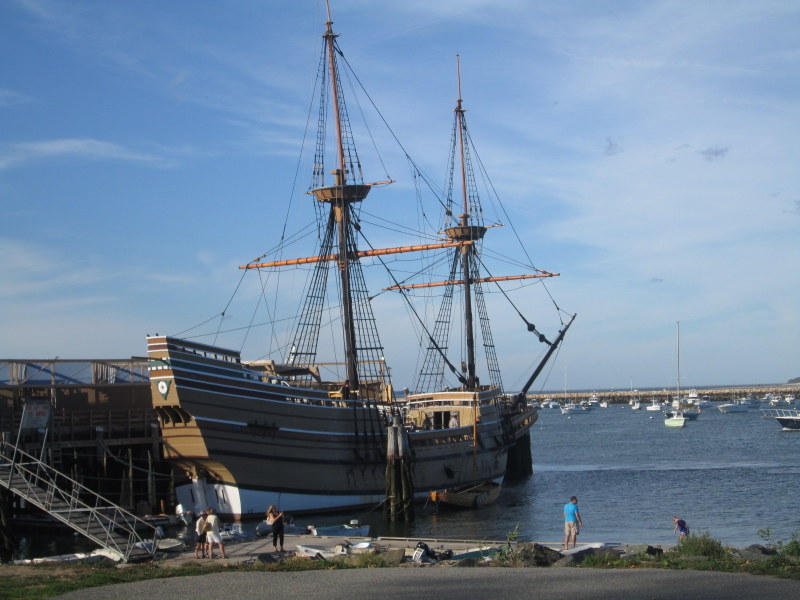
(Exact replica of the Mayflower)

The Pilgrim saga began with a group of religious dissidents who believed it necessary to separate from the Church of England.   


Persecuted in England these 'Separatists' moved to Holland in 1607.
They soon found their lives in Holland to be as difficult as they had been in England.
Joined by others the group began the move to America in 1620.


Due to a number of unfortunate delays the Pilgrims did not arrive in the new world until Dec. 1620.  All 130 passengers and crew had to remain on the ship until spring when timbers could be cut and some structures  built.


The ship was anchored some distance from shore and all transportation back and forth to land was via a small sailing vessel.  Living conditions on board were obviously miserable.


The Mayflower passengers went heavily into debt to come to America, borrowing from a group of English 'Merchant Adventurers'.  Merchants and passengers together formed a stock company, which held all money, livestock and land.  Assets were to be divided after seven years.


The colonies were not a success for the investors.   More money was borrowed to purchase supplies. The colonists eventually repaid approximately 1/3rd of the debt.


The Compact that was drawn up to govern the new colony was communal (a lot like the Shaker commune).  However, from the beginning the Church and the Government were strictly separate.


The Mayflower Passengers (approx. 130)


One year later.
"Fifty Three survived to the first Thanksgiving in 1621"


The Museum in Plymouth has a number of items that actually came over on the Mayflower:


Matchlock Musket


Sword and Scabbard


Among the Mayflower passengers were Priscilla Mullins, John Alden and Myles Standish.  Priscilla was in her late teens,  John in his early twenties, Myles perhaps 27 was widowed the first winter of 1621.
At some point John and Priscilla married and produced 11 children.   Myles Standish remarried.  Both families were among the founders of the town of Duxbury to the north of the original settlement of Plymouth.


 Henry Wadsworth Longfellow, an actual descendent of John Alden, in 1858 wrote his popular epic poem, "The Courtship of Miles Standish" out of an old family story.


Longfellow imagines Myles as a brave but inarticulate soldier who sends young John to plead his case with the beautiful Priscilla.  John is torn between duty to the Captain and his own love for Priscilla.  Priscilla, despite her maidenly reserve, chooses her own mate.


In early autumn of 1621 the 53 surviving Pilgrims celebrated their successful harvest, as was the English custom at the time.  
  The land had long been inhabited by Wampanoag, native Americans whose leader, Massasoit, befriended the Pilgrims.  Without the help of the Wampanoag, the Pilgrims would likely have starved soon after their arrival.
The Wampanoag have lived in southeastern New England for thousands of years.
The Native Peoples were familiar with Europeans, who had been exploring and fishing here since the 16th century.

Many of the Indians came to the celebration including King Massasoit, with some ninety men.  This celebration is now remembered as the First Thanksgiving.


Squanto was a Wampanoag native of Patuxet (today Plymouth).  In 1614, Thomas Hunt, an unscrupulous English sea captain, kidnapped several Natives, including Squanto, and sold them to Spain.  Somehow Squanto made his way to London where he became acquainted with English explorer Thomas Dermer, sailing back to New England with him in 1619.  He discovered his village was vacant, emptied by disease. He went on to serve as guide and interpreter between the natives and the Pilgrims and remained with the colonists until his death in 1622.


A piece of Plymouth Rock and my hand.   
I was surprised to find this rock in the museum and asked the docent about it.  She informed me that there are many pieces of the original 'Plymouth Rock' that have been chiseled away over the years.  This one piece was returned to the town probably by someone with a guilty conscience. .


Pilgrim Memorial State Park is designed around Plymouth Rock, a large glacial boulder deposited in the harbor and smoothed by centuries of tidal wash.  The rock is not only a landmark, but also a symbol of the courage and faith of the men and women who founded the first New England colony.  


"Here is a stone which the feet of a few outcasts pressed for an instant; and the stone becomes famous.  It is treasured by a great nation; its very dust is shared as a relic."  
                                       Alexis De Tocqueville, 1835


The Docent at the memorial was this very exuberant young man.  He was due to get off work and was just leaving when a dozen tourists, including myself, walked up.  Someone asked him a question and in seconds he was pouring out this great oratory on why this rock is the "Talisman of our Country", the "Symbol of our Strength," and so much more.  For 20 minutes he expounded on how, for years, people had chipped away at the rock, taking souvenir chunks home to sit on their mantels.That it was a 90 year old resident of the town that pleaded with the town council to not build a boat dock on top of what was left, and how, finally, the townspeople erected this memorial that protects what remains of the rock.  When the young man finished his amazing soliloquy there was silence, then suddenly applause.  


I think Thanksgiving is going to be even more special to me this year.