Sunday, September 23, 2012

Andersonville--Fort Sumter Prison


Midway through the Civil War, General U.S. Grant surmised that the Confederate prisoners of war he had been trading for Union prisoners were showing up again on the battlefields and replenishing the severely stressed southern army.  That realization led Grant to refuse to trade any more prisoners of war with the South.

Both sides were capturing so many soldiers by then that prisoner-of-war camps had to be built to hold them all.  It was then that Fort Sumter near the town of Andersonville was born.


The Andersonville prison opened in February of 1864 just a few miles south of Atlanta, and at its peak covered 26 acres and housed 45,000 Union soldiers.  13,000 of those prisoners died and were buried at this site before the war ended 14 months later.
(Imagine if you can, a community of 45 thousand men occupying the space of the average Super Walmart store and parking lot.)


The tranquility of the area was deceiving...


A prisoner described his entry into the prison camp this way:

"As we entered the place, a spectacle met our eyes that  almost froze our blood with horror and made our hearts fail within us.  Before us were forms that had once been active and erect...stalwart men; now nothing but mere walking skeletons, covered with filth and vermin..... 


......In the center of the whole was a swamp, occupying about three or four acres of the narrowed limits, and a part of this marshy place had been used by the prisoners as a sink--and excrement covered the ground, the scent arising from which was suffocating."


(Those monuments on the hilltop were the center of the camp.  The small drop at the foot of the hill was the site of the only water supply.) 


"Our new camp was on two steep hillsides, at the base of which was a great quagmire.  This was ditched through the center with a narrow, shallow stream, which was very sluggish on account of the small supply of water and the slight descent of the ground." 
Charles C. Fosdick, 5th Iowa Infantry, Feb. 26, 1964
  

And this was the water supply that was to sustain 45,000 men!


It was hard to imagine the suffering that occurred here.


This is a partial replica of the stockade that surrounded the camp.


No battle was fought here--the cannons were for protection against prison riots.


And, as evidenced in many of the pictures that were taken of the area, the shelters were rudimentary and only available for a small number of the men.


Just imagine the heat of a Georgia summer, the smell of the sink, the flies, mosquitoes, no food, no water and minimal clothes....


But the reality hit me the hardest at the cemetery....
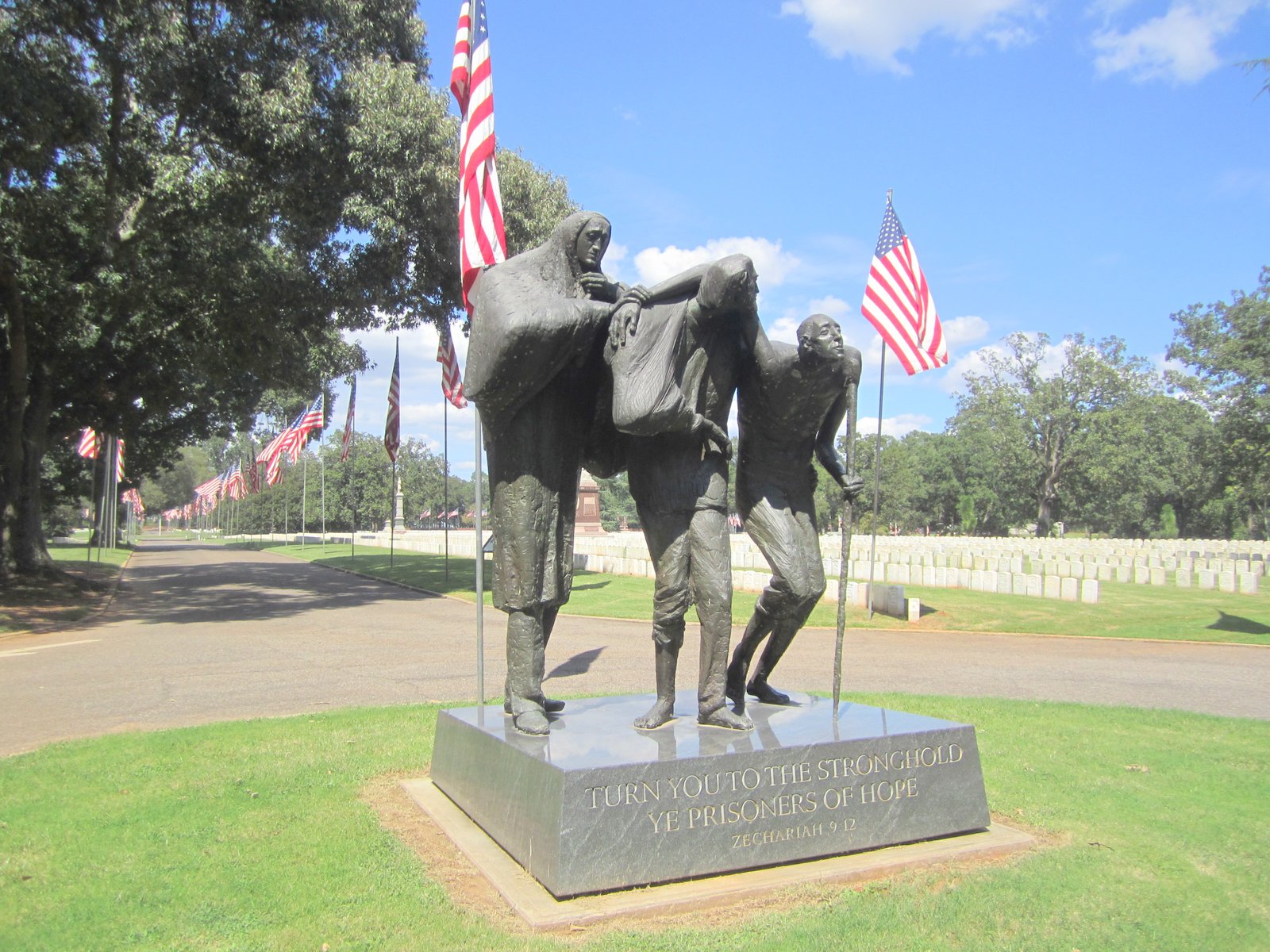


This cemetary lies deep in the heart of the south, 50 miles below Atlanta, yet there is only one confederate soldier buried here--all the rest were Union soldiers.


  The prisoners' headstones are only inches apart.  As the death rate at Andersonville escalated to 100 per day, officials abandoned the use of pinebox coffins and had the bodies buried shoulder to shoulder in trenches. 


 "If a man died in good clothes he was buried nearly naked.  The living needed apparel; the dead none."
G.E. Reynolds, 86th Ohio Infantry, August 3, 1864


At first only numbered stakes marked the prisoners' graves.  The dead might have remained unidentified except for the efforts of Dorence Atwater, a former prisoner.  
Prison officials assigned Dorence Atwater to keep records of the dead.  Hoping to notify bereaved relatives after the war, Atwater made a second copy of the death list, which he smuggled out in the lining of his jacket.  When he accompanied Clara Barton (the nurse) to Andersonville in July 1865, they were able to match his list with the numbered stakes.  Each prisoner could then be honored by name.
(from Historical Marker)


After the war there was a trial for Captain Wirz, the southern officer in charge of Fort Sumter prison camp.  He was found guilty of  conspiracy and murder and was executed.

(I hope this is my last visit to a Civil War site.  But I thought this was too revealing not to include it in this blog)

"The Civil War was the defining event in United States history.  The war brought an end to slavery and established the Union as perpetual.  The costs were devastating: 620,000 deaths and billions of dollars. War brought widespread destruction, especially in the South, where most of the fighting occurred.  The Civil War and its legacy continue to shape American life today.  Each generation must come to terms with this great rupture in the national past."

Thursday, September 20, 2012

Jimmy Carter--Peanut Farmer

I drove into Plains and stopped at the Visitor's Center to find out what there was to see pertaining to the hometown of our 39th president, Jimmy Carter.

  
First of all I discovered that Plains has only 2 main streets so it was highly unlikely that I would get lost.


Next, I discovered that everywhere I went the people were as lovely and gracious as any I have found along the way--and they also seem to have all the time in the world to talk to me and tell me about 'their wonderful Jimmy.'
 
I heard that he was 'real', 'caring', 'friendly', 'a boyhood friend',  'a great family man', 'genuine', 'my neighbor'.....wait a minute!  A neighbor?  I had to ask, "Where do the Carters live now?"  and I was told, "Just two blocks down the street."
  

"So, is he in town now?" I wondered.
"Yep, and if you just sit around awhile he'll probably stop by."


Well, sitting on one of those chairs and waiting for Jimmy to come strolling by seemed mighty inviting but I wanted to see more of his home town.

 Right away I espied his brother's gas station.  I remembered the hay-day of "Billy Beer" and all the jokes about Jimmy's crazy brother.  Billy's gone now but I also remembered that Jimmy Carter never tried to dismiss or distance himself from his brother, no matter how crazy the incidents or the comments Billy made to the press. I always thought that was commendable.  After all, we don't choose our relatives and we aren't responsible for them, even though we share some DNA. (My sisters say that about me all the time.)   Besides, what could be harder than being the relative of a president?  Ask Amy or Chelsea, the Bush twins. Or a few of Obama's relatives.


I found his high school and learned that it had been refurbished and made into a museum to honor the president.

There was no problem parking.  There were only a couple of other tourists in the town.  I was told that 'things have quieted down quite a bit the last few years.'


Excerpts from various brochures & pamphlets.....
(James Earl "Jimmy" Carter, Jr. served as the 39th President of the United States, was the recipient of the 2002 Nobel Peace Prize, and was the only U.S. President to have received the Prize after leaving office. It was awarded for his decades of untiring effort to find peaceful solutions to international conflicts, to advance democracy and human rights, and to promote economic and social development.)
 
There was a replica of the desk in the oval office  and I just had to try it out.  I do look presidential, don't you think? 


(The accomplishments of his administration included the Panama Canal treaties, the Camp David Accords, the treaty of peace between Egypt and Israel, the SALT II treaty with the Soviet Union, and the establishment of U.S. diplomatic relations with the People's Republic of China. He championed human rights throughout the world. On the domestic side, the administration's achievements included a comprehensive energy program conducted by a new Department of Energy; deregulation in energy, transportation, communications, and finance; major educational programs under a new Department of Education; and major environmental protection legislation, including the Alaska National Interest Lands Conservation Act.)

However, the main focus of the museum is on the work he has done since leaving office: 

I remember desks like these.  The volunteer at the museum said most kids that see them think the hole in the desk is to hold the students drink.


Maranatha Baptist Church

I learned that he and his wife, Rosalynn, spend one week per year at Habitat for Humanity building homes, that he has written 27 books, and he teaches Sunday School when in town at Maranatha Baptist Church.  One of the docents suggested I stay until Sunday and join his class.  (Boy, that would have been a cool Blog entry! But I declined.)

I always liked Jimmy Carter but I am most impressed with his achievements after leaving office.  He has set a high standard for our other ex-presidents to follow--I just wish some of them would follow his example a little more.


This is the original farm house.  I drove by the house they live in now and have lived in since 1961.  It was impossible to take a picture, there is a fence and lots of vegetation around.  But I saw a lot of cars in the drive--the kids and grandkids must be visiting.


"I am," he once wrote, "a Southerner and an American.  I am a farmer, an engineer, a father and husband, a Christian, a politician and former governor, a planner, a businessman, a nuclear physicist, a naval officer, a canoeist and, among other things, a lover of Bob Dylan's songs and Dylan Thomas' poetry."

I think he is a pretty nice neighbor as well. 
I wanted to visit the Carter Center in Atlanta but didn't get there.

The Carter Center is a nonpartisan and nonprofit Center that addresses national and international issues of public policy. The Carter Center fellows, associates, and staff join with President Carter in efforts to resolve conflict, promote democracy, protect human rights, and prevent disease and other afflictions.Through the Global 2000 programs, the Center advances health and agriculture in the developing world. It has spearheaded the international effort to eradicate Guinea worm disease, which will be the second disease in history to be eliminated.
President Carter and The Carter Center have engaged in conflict mediation in Ethiopia and Eritrea (1989), North Korea (1994), Liberia (1994), Haiti (1994), Bosnia (1994), Sudan (1995), the Great Lakes region of Africa (1995-96), Sudan and Uganda (1999), Venezuela (2002-2003), Nepal (2004-2008), and Ecuador and Colombia (2008). Under his leadership, The Carter Center has sent 91 election-monitoring missions to the Americas, Africa, and Asia. These include Panama (1989), Nicaragua (1990), Guyana (1992), China (1997), Nigeria (1998), Indonesia (1999), East Timor (1999), Mexico (2000), Guatemala (2003), Venezuela (2004), Ethiopia (2005), Liberia (2005), the Democratic Republic of the Congo (2006), Nepal (2008), Lebanon (2009), Sudan (2010), Tunisia (2011), and Egypt (2011-2012).


Wednesday, September 19, 2012

Bottle Trees--A southern tradition

BOTTLE TREES

Bottle trees are a product of southern black culture with roots in the animistic spiritualism and totemism of several African tribal cultures. 


  Glassblowing and bottle making existed as far back as the ninth century in Mica, and the practice of hanging found objects from trees or huts as talismans to ward off evil spirits also existed.  The bottle tree was a Kongo-derived tradition that conveyed deep religious symbolism.


The bottle tree was once common throughout the rural Southeast.  The artifacts were made by stripping the foliage from a living tree, with upward-pointing branches left intact.  Bottles were then dropped over those branch ends.  Cedars were a preferred species, because cedars were common, resisted decay and were well-shaped with all branches pointing upward.


Folk custom dictated that spirits would enter the bottle because of the bright colors and become trapped.  When the wind blew and shook the tree, the spirits could be heard moaning inside the bottles.   


In some cases, paint was poured into the bottles before hanging them on the trees.  This was done  to help trap spirits.


Today bottle trees are scarce.  Those that exist in northeast Mississippi, for example, are produced by rural whites as often as blacks.  Like the hex signs of Pennsylvania Dutch barns, they are a vestige of the past, produced more for works of art than for protection from the supernatural.  They can be beautiful and even the worst examples are still curiosities.

(look closely--it's there)


Southern authors, notable Eudora Welty, have commented on bottle trees, perhaps because the trees have a primal fascination.  Sunlight on and through colored glass has charmed people for centuries.  The bottle tree can be considered the poor person's stained glass window.

(verbiage copied from a sign at the visitor's center in Plains, Ga)


And when I go back into a house with a garden I think I will start one of my own.  

Tuesday, September 18, 2012

Georgia Rural Telephone Museum--and more!


Upon leaving Don's I headed to Winter Haven for a night with my buddy, June Sherman.  We had dinner and played a rip-roaring game of Skip-Bo before I retired for the night to sleep in the parking lot. (Don't you think house guests are more welcome when they sleep in their own vehicles?) I won't be back in Florida for a while so this was a temporary goodbye... However, June has a standing invitation to join me at any time along the way.

Next stop--Georgia!


One of the neatest things about this voyage is what I call 'Serendipity'.  I was on the way to Plains, Ga when I decided to wander off the main road for a while and look for a place for lunch.  The road sign pointed left with the name of the town a mile away--'Leslie'.  (That was the name of my father-in-law and it is the middle name of my youngest son so I felt I had to check it out)  The first thing I saw as I rolled into this tiny rural community is the above old building.  I really did not expect to find more than a dozen phones and maybe a booth or two inside so I thought I would just peek in for a minute....
 
Yep, here's the phone booth...

But, inside was a revelation.  There were hundreds--and hundreds--of phones.  Before long I began to feel like eyes were following me.


Lots of eyes....


The dioramas were very lifelike, and I have to say, very informative.  Looking at all those wires I realized what a chore it must have been to get a phone line to every home and business in the country.


Some of the phones were absolutely works of art.

Whoops! Some of the dioramas were almost too lifelike.

I never found a cell phone or an Iphone....
 
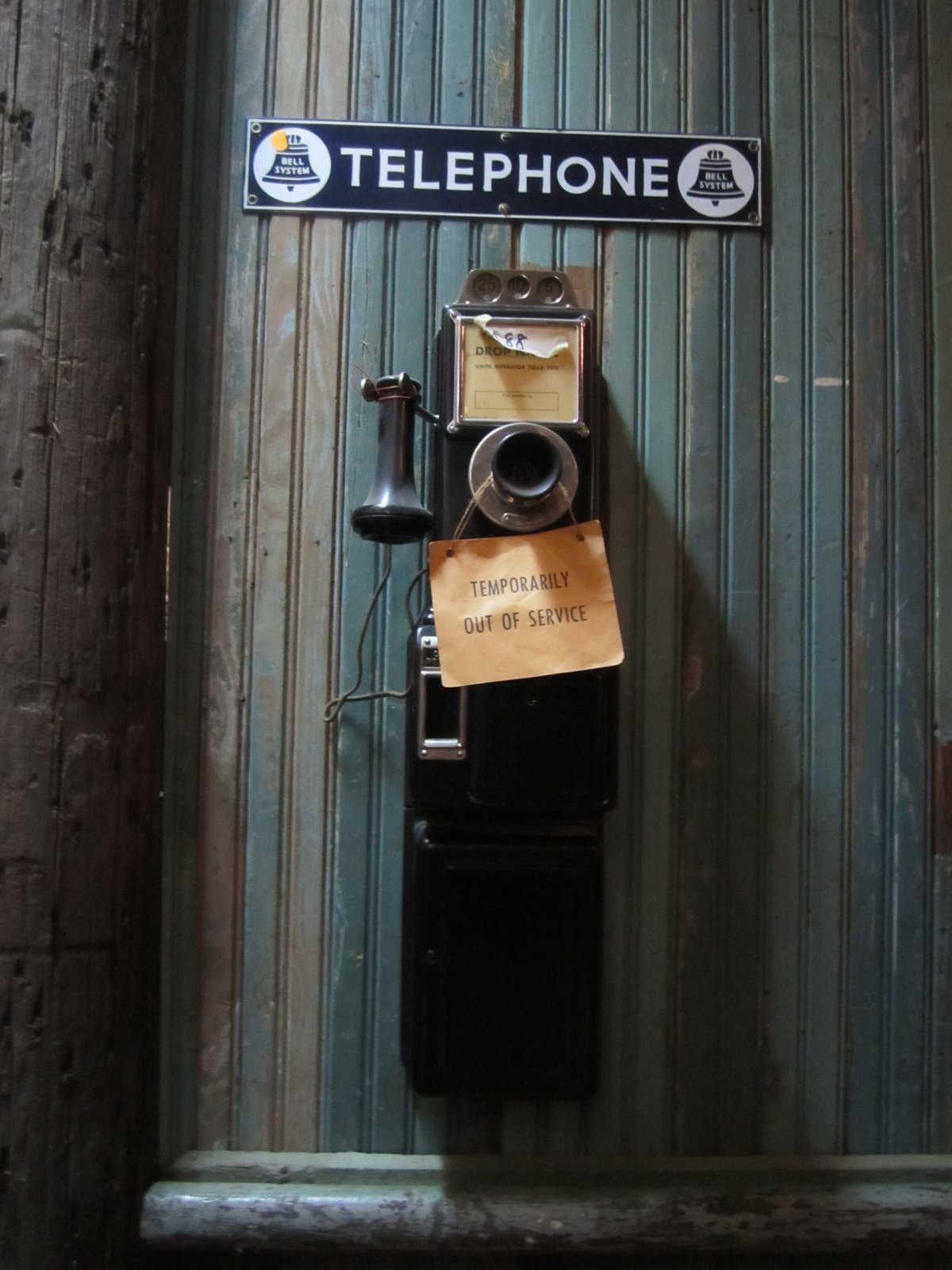
Temporarily Out of Service ?
  
But I saw every other kind of phone--and most of them I remember.
  
 
I wandered from room to room through this old warehouse and marveled at the amazing collection of memorabilia from an era that is fast disappearing from our memories.

I do not know the last time I saw a Bell Business Office but now there is a Verizon store in every town and shopping center that I come to.

And for my kids--I actually sat and and worked one of these switch boards many years ago. 


And just to let you know how amazed I was at finding this charming museum--here is the town it is a part of....

And before we leave Leslie I also found a second part of the same museum that I just have to share. My car addict friends will enjoy the following pictures.....